

Adelphi University’s roots reach back to 1863. Over the next 100 years, Adelphi grew and changed significantly. In 1929, Adelphi University became the first private, coeducational institution of higher education on Long Island. Since that time, more than 100,000 students have passed through its doors.
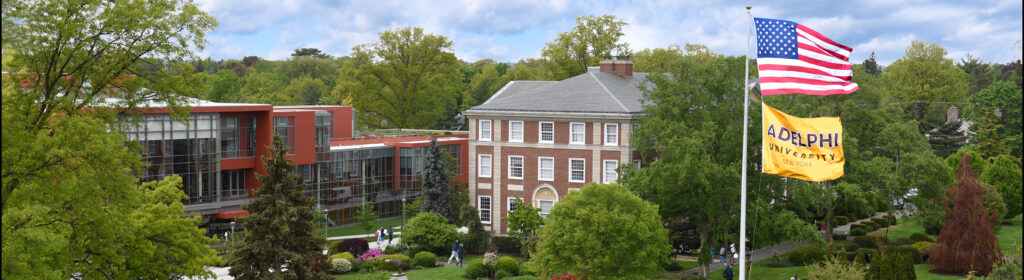
Today, Adelphi is thriving. Its colleges and schools include the College of Arts and Sciences; the Gordon F. Derner School of Psychology; the Honors College; the Robert B. Willumstad School of Business; the Ruth S. Ammon College of Education and Health Sciences (comprised of the School of Education and the School of Health Sciences); the College of Nursing and Public Health; the School of Social Work; and the College of Professional and Continuing Studies. Its faculty leads the way to ensure that students receive the finest education in the region and that Adelphi continues to serve as a vital resource to communities far and wide.
With a student/faculty ratio of 10:1, students have the resources needed to reach their goals, including state-of-the-art lasers for two new physics laboratories, an atomic scanning microscope and a nuclear magnetic resonance machine for the chemistry program, and enhanced digital music facilities to support its music and performing arts programs. This includes the Adele and Herbert J. Klapper Center for Fine Arts with space for painting, printmaking, sculpture and ceramics; the Center for Recreation and Sports, containing gyms and an indoor track; the Performing Arts Center (AUPAC) includes a 500-seat Concert Hall and additional performance, rehearsal and classroom space for music, theatre and dance; an outdoor sports complex; a 76,000 square foot state-of-the art sports and recreation center for Adelphi’s highly regarded academic programs in health and physical education and sports management with a modern exercise room, pool, indoor track and gym.
Currently, more than 7,400 students are at the main Garden City campus and at centers in Manhattan, Hauppauge, and Poughkeepsie. Its students have gone on to achieve awards and national recognition for their scholarship, service and leadership.
Scholars throughout the University are making significant contributions to their disciplines. In recent years, Adelphi faculty members have been recognized as Fulbright and Hartford Scholars, and have received funding from the National Endowment for the Humanities, the National Institutes of Health and the National Science Foundation.
Adelphi seeks to serve its locality, state and nation through the research and practice of its faculty; the strengthening of ties between the professional schools and community; the staging of distinguished cultural events at its campuses; and most essentially, the education of a generation of future leaders and informed citizens, professionals, and community members.