2026 · Participant reflections
Two museums.
Many perspectives.
Lasting change.
The visits are only the beginning. Our participants carry these histories, connections, and conversations into their communities—and into what comes next.
“By understanding history, we can recognize warning signs and prevent similar injustices in the future.”
In their own words.
We asked our 2026 participants to reflect on this year’s experience. Here’s what they wrote.
“We will need to resist intolerance and choose love instead, even if it means defying authority.”
Adeline Johnson
St. Olaf College
Read full reflectionClose full reflection
St Olaf College – Junior – Intern at Legal Aid DC
Being a part of the Two Museums Program was truly life-changing in a number of ways. I have always been a curious student of history, but one thing that this program taught me is that there is no textbook that can truly teach you about the lived experiences of torture, hatred, and intolerance that marginalized groups have faced throughout history—but physically placing myself in proximity with renowned scholars, survivors of genocide, and artifacts of history gave me something that the textbooks couldn’t.
Each speaker brought a unique and critical perspective to this program, and I can confidently say that while all of them taught me something, they also left me with questions that I will continue to reflect upon as I continue my academic journey
Professor Katz offered a historical analysis of the Jewish Question beginning in the Middle Ages to the rise of the Nazi Party and Hitler. While there is no doubt that history reveals patterns of Jewish hatred and intolerance, I am still left questioning how the most educated, scientifically advanced nation in the world could endorse something as logically weak as the Final Solution. This makes me fear the destructive possibilities of my own government; because of this fear, I feel the need to resist hate and discrimination despite the costs, because as I learned from Peter Feigl, courageous resistors are our saviours when the people in power disregard humanitarian principles.
Through sharing his experiences, Peter showed us how easy it is to fall into the cycle of hatred, and how difficult it can be to love in the face of intolerance and political propaganda. One of the questions Peter left me with is, “How do we stop the process of young, naïve innocence from transforming into complacency and unflinching obedience?”
Overall, the visits and lectures in this program taught me the qualities that our future generation of leaders will need to uphold in order to avoid reliving the atrocities of the past, and how I can continue to build those qualities within myself to build a brighter future. We will need to resist intolerance and choose love instead, even if it means defying authority. This takes immense courage, but change is impossible without persistence. I will do this by using my leadership positions as a platform to speak out against discrimination, injustice, and hatred. I will make it my mission to create leadership teams that want to achieve progress and aren’t afraid to be bold in the face of intolerance.
“Hearing and learning from people so closely connected to these histories made the past feel real and immediate.”
Kennedy Stewart
Tennessee State University
Read full reflectionClose full reflection
Tennessee State University, Sophomore (Intern at Coldwell Banker Richard Ellis- Comm Real Estate)
The TMP experience gave me a deeper understanding and appreciation of history, personal narratives, and the power of storytelling. Hearing and learning from people so closely connected to these histories made the past feel real and immediate. It reinforced the importance of preserving stories, artifacts, and lived experiences so that future generations can learn from them and ensure these histories are never forgotten.TMP showed me how storytelling can be a powerful tool to educate, inspire, and bring people together. I plan to apply these skills by being more intentional in my interactions with others, encouraging open and respectful dialogue, and speaking up when I encounter injustice. By sharing what I have learned, I hope to help create environments where individuals feel valued and heard.
A meaningful moment for me was learning about individuals who faced discrimination and hatred yet chose to educate others and promote understanding. Their resilience and courage inspired me to reflect on my own role in combating antisemitism, racism, and all forms of hatred. This program made me realize that change begins with awareness, but it must be followed by action. For me, this means speaking out against discrimination, supporting educational efforts, and continuing to learn about different cultures and histories. I also want to encourage others to have these important conversations, so we can work together toward a more inclusive and respectful society.
TMP is more than just an educational program; it is a transformative experience that helps individuals grow as leaders and community members. It gives participants the tools and inspiration to carry these lessons forward and make meaningful contributions to the world.
“My goal before the TMP was always to stop the spread of hatred and rather spread empathy, understanding, sympathy, and love.”
Victoria Schweigert-Opas
George Mason University
Read full reflectionClose full reflection
George Mason University – Junior
One of the most heart-wrenching aspects of the Two Museums Program was the visit to the Holocaust Memorial and Museum. My paternal grandmother was born in Latvia in 1942, during World War II. Latvia was a nation actively suffering at the hands of Antisemitism, Nazi power, Soviet Influence, and all the other negative effects of war. Although she is not Jewish, there were many around her who were, and seeing the reality she grew up in formed a pit in my stomach. Although the Nazi’s hatred was first aimed at Jewish people, it grew, and even those who weren’t engulfed in their broadening circle of hatred were left with great trauma and scars that have led to things like epidemics like alcoholism, addiction, and other unhealthy coping mechanisms. Hatred harms all, not just the party or individual it is meant for; it is a sickness — maybe even a disease — that reaps till there is nothing left. My goal before the TMP was always to stop the spread of hatred and rather spread empathy, understanding, sympathy, and love. My goal after having completed the Two Museums Program stays the same, but now I have an emboldened and roaring flame under me that fuels and guides me with invigorated passion. I would most certainly recommend my peers to engage and take part in the Two Museums Program/Scholarship.
“It is important for us young people to learn from and witness past tragedies, so we don’t repeat history.”
River Le
George Mason University
Read full reflectionClose full reflection
George Mason University – Junior
From the Two Museums Program, I have understood and witnessed what it means not only for a community to have solidarity through shared living experiences, but for two communities to come together to help one another out. This experience has sharpened my leadership skills because the program has shown that two completely different people can have similar stories, and that kindness can take you far.I would recommend participating in the TMP program to others because we learn that hate is created and spread to others. People are not born good or bad; they are a blank slate that learns from the people around them and the environment in which they are nurtured.
It is our duty, as future leaders, to make sure America’s history with oppression, racism and antisemitism won’t be gone from our history books, and we continue to fight for what is right. There is also history that others may not yet have seen or learned about. For example, I personally did not know that the Black and African American community and Jewish community were connected via the Civil Rights movement, and there’s more to it than just that as well. It is important for us young people to learn from and witness past tragedies, so we don’t repeat history.
“TMP reinforced the importance of standing up against bias and ensuring that all people feel seen, heard, and valued.”
Nigsti Asmerom
George Washington University
Read full reflectionClose full reflection
Sophmore – George Washington University
The Two Museums Program (TMP) was a meaningful experience that deepened my understanding of history, leadership, and the responsibility we all share in combating antisemitism, racism, and other forms of hatred. I learned how prejudice and discrimination have shaped societies and how individuals can make a difference by speaking out and advocating for others. One of the most valuable lessons I gained from TMP was that leadership is not just about holding a position. It is about empathy, courage, and action. TMP reinforced the importance of standing up against bias and ensuring that all people feel seen, heard, and valued. It inspired me to continue advocating for inclusive spaces, supporting underrepresented communities, and engaging in conversations that promote understanding and respect. Moving forward, I plan to apply these lessons through my leadership roles, mentorship opportunities, and future career. I want to be someone who not only recognizes injustice but also takes action to address it, whether by amplifying marginalized voices, fostering meaningful dialogue, or supporting initiatives that promote equity and inclusion. I would highly recommend the TMP Scholarship Program to others because it offers a unique opportunity to connect history with the challenges we face today. The program encourages personal reflection, exposes participants to diverse perspectives, and develops leadership skills that can be applied far beyond the classroom. TMP is more than an educational experience. It is an opportunity to grow as a leader and become a more informed and compassionate member of society.
“We need to begin / continue to break down the barriers of In-group/out-group ideas and learn about each other and embrace our differences.”
Lily Spoerke
St. Olaf College
Read full reflectionClose full reflection
St Olaf College – Junior – Intern at Legal Aid DC
This experience gave new insight and perspectives into the lives and experiences of people directly affected by at least two of mankind’s darkest moments. Learning about this experience from these people made it even more real than it would have been to simply read about it in a book or online. Also with this experience, I got to learn about all of this with other people my age who also have similar interests. This program allowed me to learn about these important topics and to meet new people who I can connect with in the future to make even more change when I graduate from college. This coming academic year, I will be serving as the President of the St. Olaf Student Government Association, which means I have a real opportunity to further what I have learned with this program and reach a broader audience of people at St. Olaf.
The two experiences with this program that were most impactful to me were having Holocaust Survivor Peter Feigl and Carl Wilkins speak about their experiences. With Peter, I had previously studied the town of Le Chambon-sur-Lignon in one of my classes my first year at St. Olaf, so it was an even more impactful experience to hear from him about what happened there and what the community was like. I later emailed the professor I had for that class, and she was so excited to hear that I had met someone who had been helped there.
This program teaches us about important and pressing issues in today’s society in a way that allows for a deeper understanding and learning with other people who believe in something similar. TMP is an opportunity for learning and community building. We need to begin / continue to break down the barriers of In-group/out-group ideas and learn about each other and embrace our differences.
“Participants are united in the commitment to learning, meaningful dialogue, and positive change within respective fields of study.”
Gabi Maldonado
George Washington University
Read full reflectionClose full reflection
George Washington University – Sophomore
The Two Museums Program (TMP) experience provided the framework to make positive change within a community. Taking part in the TMP has made me more aware of issues that continue to impact minority communities.
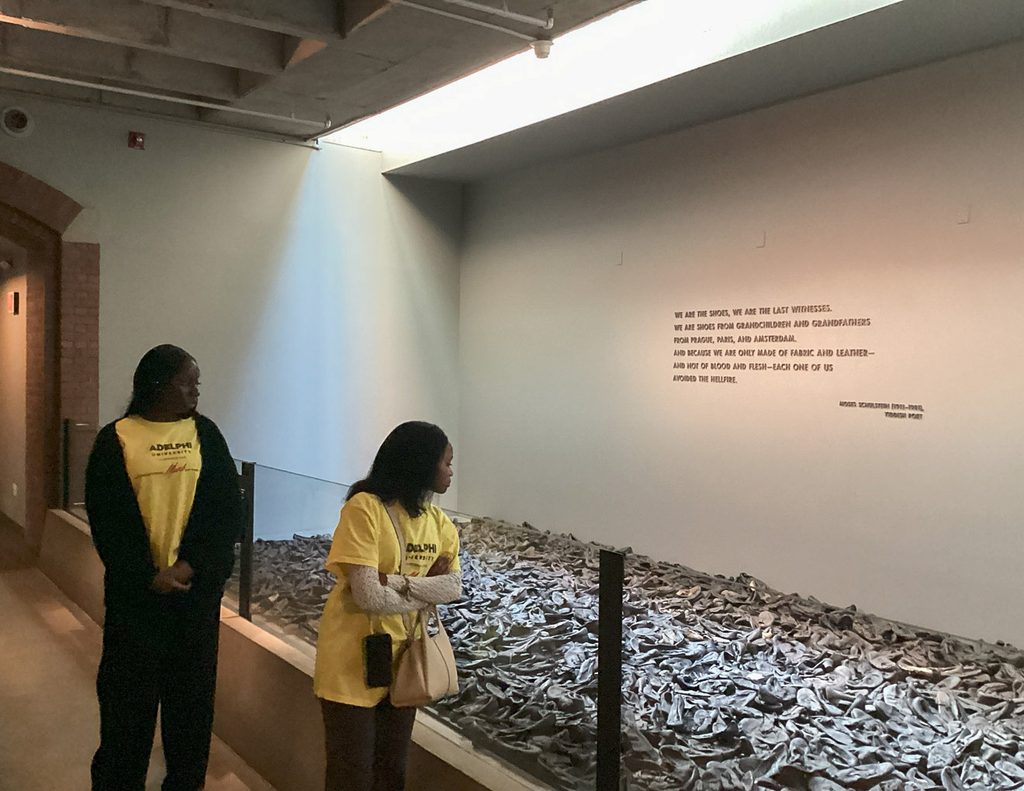
In the U.S. Holocaust Memorial Museum (USHMM), being in the presence of the shoe memorial had a strong emotional effect on me. It is truly unimaginable how physical items could be valued over a human life. This was further proven by Holocaust survivor Peter Feigl’s testimony, a Holocaust survivor. He recalled that his father’s final act was giving him a small pouch containing all of his parents’ valuables.
I would recommend the Two Museums Scholarship program to others because it created a safe space for students to come together for a common goal of understanding difficult histories in hopes of contributing to a better future. Participants are united in the commitment to learning, meaningful dialogue, and positive change within respective fields of study.
“From the TMP experience, I gained a sense of leadership that corresponds with advocacy.”
Paulene Tinio
New York University
Read full reflectionClose full reflection
Sophomore – NYU
The Two Museums Program brought me hope and understanding about the consequences of our past, and what we can do to better our future. The experience helped me understand my current position as a young adult and the capacity I hold in order to contribute toward change.
From the TMP experience, I gained a sense of leadership that corresponds with advocacy. In my future, I want to use these skills to advocate for other communities and encourage others to learn more about our past, because hatred is not rooted only within Jewish and African American communities. This experience has fostered a deeper curiosity in me to explore and understand more communities whose histories have been overlooked, and to use that knowledge to make an impact.
“I believe that change begins with committed people and intentional work.”
Hadassah Marshall
University of Maryland
Read full reflectionClose full reflection
University of Maryland – Graduate Student
While my experiences differ from those of other marginalized groups, they have taught me the importance of empathy, allyship, and standing against injustice in all its forms.
Studying racism, antisemitism, hatred, and intolerance is necessary for progress because these forces continue to persist within the institutional structure of societies and negatively impact everyday people’s lives. By understanding history, we can recognize warning signs and prevent similar injustices in the future.
I believe that change begins with committed people and intentional work. I am confident that my participation in the Two Museums Program has better prepared me for a career in law and policy reform.
“This program really taught me about how much we have to offer each other when we try to find things in common with people we would’ve never talked to.”
Gabrielle Moore-Lee
Howard University
Read full reflectionClose full reflection
Howard University – Senior – Intern for Senator J. Ossof
If l could use one word to describe the Two Museums Program, it would be transformative. This program really taught me about how much we have to offer each other when we try to find things in common with people we would’ve never talked to.
With antisemitism on the rise and anti-Black racism on the rise, and watching the actions of the current presidential administration, I’m struck by how many similarities I’m seeing with how undocumented people are being treated as inhumane and being othered, and similarly to what we learned about from the program, about how discrimination became increasingly prevalent for African-Americans and Jewish people, is propaganda of minorities becoming the sole reason for all of society’s problems.
“I have always wanted to make a difference, but TMP helped me understand that meaningful change begins with education, empathy and the courage to confront injustice.”
Marieme Sambe
George Washington University
Read full reflectionClose full reflection
George Washington University – Sophomore
The TMP experience gave me a deeper understanding of history, leadership, and the responsibility that comes with using my voice to create positive change. I left the program with a greater appreciation for the power of education, advocacy and most importantly, empathy.
Going into college, I wanted to make sure I engaged in meaningful conversations about social justice and advocating for individuals whose voices are often overlooked, and taking the skills I have learned in the Two Museums Program, I know I will be able to do so. This experience inspired me because it connected to my desire to dedicate my future to advocating for those who were silenced. I have always wanted to make a difference, but TMP helped me understand that meaningful change begins with education, empathy and the courage to confront injustice. I hope to take everything I’ve learned and continue to apply it to my everyday life.
The program helps you connect the past to the present in a powerful way which as I stated earlier, is a key component to truly making a change. It showed me that antisemitism, racism, and other forms of hatred do not appear suddenly; they often grow from misinformation, prejudice, and most importantly, miseducation
“Although every person may have a seat at the table nowadays, not every person has a microphone to speak.”
Chelseaparis Henry
Spellman College
Read full reflectionClose full reflection
Spellman College – Sophomore – Intern for Senator R. Warnock
At the end of the Two Museums Program (TMP), I acquired vital knowledge about the history of Black and Jewish relations and an understanding of how to use it as a force for global change. The most influential theme that I observed was that we are stronger together. One group may be mighty by itself, but coming together could invoke monumental change. I will leverage this key lesson to sharpen my leadership skills by embracing diversity as a key factor for success. Although every person may have a seat at the table nowadays, not every person has a microphone to speak. I will go forward in life by sharing my own microphone with those who do not have one. I will ensure that everyone at the table has an opportunity to voice their thoughts, opinions, feelings, and experiences in order to see different perspectives that may be essential to cultivating prosperity.
I would highly recommend the Two Museums Program because it taught me invaluable information. From the intellectual lectures with guest speakers to the visits at the museums to bonding with other TMP participants, this experience was such a benefit to my learning as a scholar and to my growth as a person. Thus, the Two Museums Program has helped prepare me for a future dedicated to fighting for justice for
“I would recommend the Two Museums Program to people because the friendships I made and the stories I heard during my time were very special.”
Dana Burnett
Barnard College
Read full reflectionClose full reflection
Barnard College – Freshman – Intern for U. S. Representative G. Meeks, NY-05
I would recommend the Two Museums Program to people because the friendships I made and the stories I heard during my time were very special.
“The program was above and beyond what I thought I was going to receive.”
Charles Campbell
Samford University
Read full reflectionClose full reflection
Junior – Samford University – Intern for U. S. Representative Chris Smith, NJ-04
First off, I just want to say thank you for this incredible opportunity. It has impacted me in many ways. The program was above and beyond what I thought I was going to receive. While all the speakers were superb, the topic of the Rwandan genocide really hit me.
“The lessons I learned will stay with me long after the program has ended.”
Theresa Paris
Franciscan University of Steubenville
Read full reflectionClose full reflection
Franciscan University of Steubenville, Sophomore – Intern: U. S. Representative Chris Smith, NJ-04
The Two Museums Program was one of the most meaningful experiences I participated in during my internship in Washington, D.C. Before the program, I expected to learn more about history, but I did not expect the museums and discussions to have such a personal impact on me.
Seeing personal belongings, photographs, and firsthand accounts made the experiences of real people feel much more tangible. It was impossible not to think about the individuals and families whose lives were forever changed by hatred, discrimination, and injustice.
What stood out to me most was the resilience of the people represented in both museums. Despite facing unimaginable hardships, many individuals chose courage, perseverance, and hope. Their stories reminded me that even in the darkest circumstances, people have the ability to make a difference and to stand up for what is right. I also appreciated the conversations and lectures throughout the program. Listening to different perspectives challenged me to think more deeply about leadership, responsibility, and the role each of us plays in our communities. The discussions were respectful, thoughtful, and often pushed me outside of my comfort zone in a positive way. They reminded me that understanding history is not just about learning facts as much as it is about learning how to engage with others and how to approach difficult topics with empathy and respect.
The Two Museums Program gave me a deeper appreciation for history, exposed me to perspectives I might not otherwise have encountered, and challenged me to think more intentionally about how I can contribute to my community. The lessons I learned will stay with me long after the program has ended.
“It was a refreshing reminder that learning doesn’t always happen in a classroom.”
Aliya Fodkar
St. Olaf College
Read full reflectionClose full reflection
St. Olaf College – Freshman – Intern at Lutheran Centre of America
.Looking back on the two museum visits, I realize they were much more than just a chance to see interesting exhibits. They gave me the opportunity to step away from my usual routine, slow down, and spend time thinking about the stories, people, and histories behind what I was seeing. It was a refreshing reminder that learning doesn’t always happen in a classroom.
“I came in a contractor. I am leaving a student.”
Simon Santodomingo
Returning college student · Videographer
Read full reflectionClose full reflection
Returning College Student – Videographer
. In my life, I have spent years untangling tangled politics for Spanish-speaking immigrant audiences in the United States, and I’ve seen it, thus far, as a craft that allows me to explore the topics I’m passionate about. Alongside it comes a set of techniques I had gotten reasonably good at. This structure gave me stability and a framework, which I found comfortable to swim in. The program, surprisingly, dismantled that comfort. It kept insisting that the work was custodianship instead, and that I had been practicing it without quite grasping what I was holding. Now, I think I could fly.
The first thing to undo me was sitting across from a Holocaust survivor. I have read the history; I know the figures. None of it prepared me for the particular gravity of a person who carries the thing inside his own memory, speaking in the first person about what the books render in the third.
Dr. Berger’s argument-that an enormous share of American freedom and culture was forged in the relationship between those two peoples-rearranged how I understood the Civil Rights era. I had filed it as parallel struggles in my brain. She showed me it was an alliance: distinct griefs deliberately braided into a common cause.
Rwanda is where the program came closest to my own bones. I grew up watching language calcify in Venezuela-watching the word “opponent” curdle into “traitor,” watching neighbors get reclassified as threats- and my own father, a journalist, forced into exile for telling the truth. I know how short the distance is from a shift in vocabulary to the normalization and justification of violence.
Returning to the Holocaust Memorial Museum a second time, I found myself witnessing it less through my own eyes and more through the eyes of the rest of the TMP student cohort. Seeing people react to things for the first time that I reacted to close to 10 years ago was like seeing the museum in second person. However, the corridor of shoes still affected me the same, as I suspect it always will. Thousands of them, the leather split and curled inward, each one shaped to a foot that no longer exists.
My first visit to the National Museum of African American History and Culture struck with equal force. Moving through slavery, the long fight for civil rights, the fierce internal arguments over how resistance ought to be waged, I kept returning to a single phrase-“We the People”-and how violently contested and repeatedly rewritten its membership has been
At the end, the program gave me the nerve to go back and finish the bachelor’s degree I set down years ago. I built a career on the conviction that telling the truth plainly matters. Sitting in those rooms, listening to survivors and historians, I understood that I had been doing the work without the foundation it deserved. I came in a contractor. I am leaving a student.
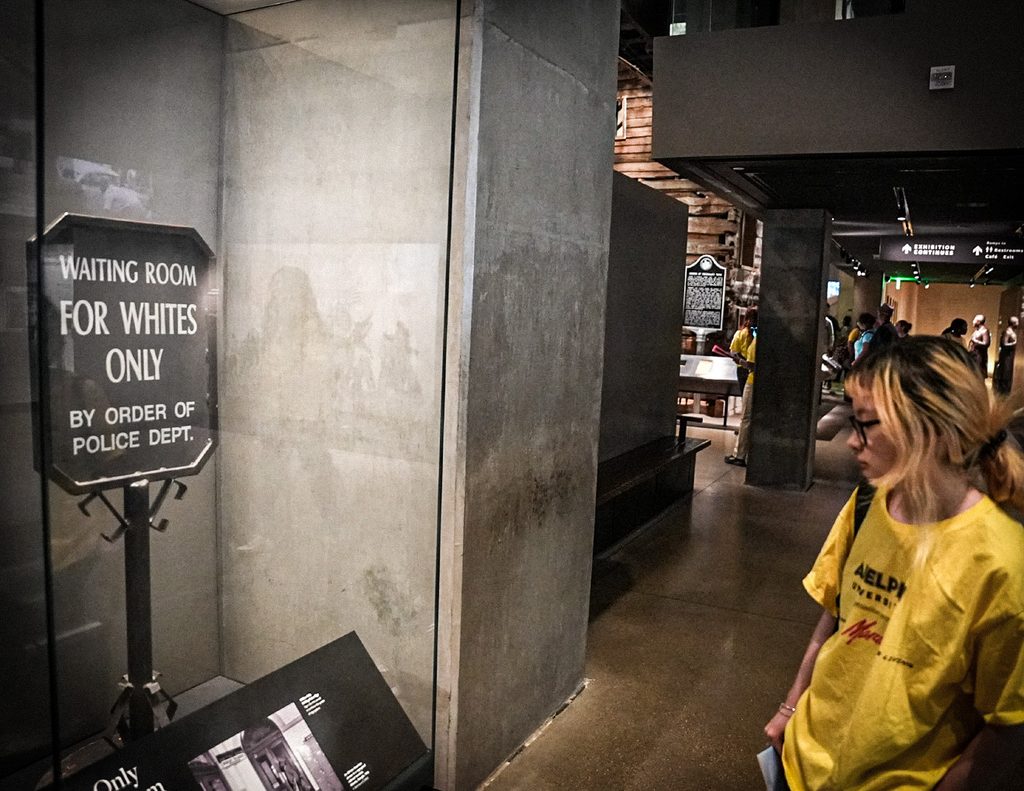
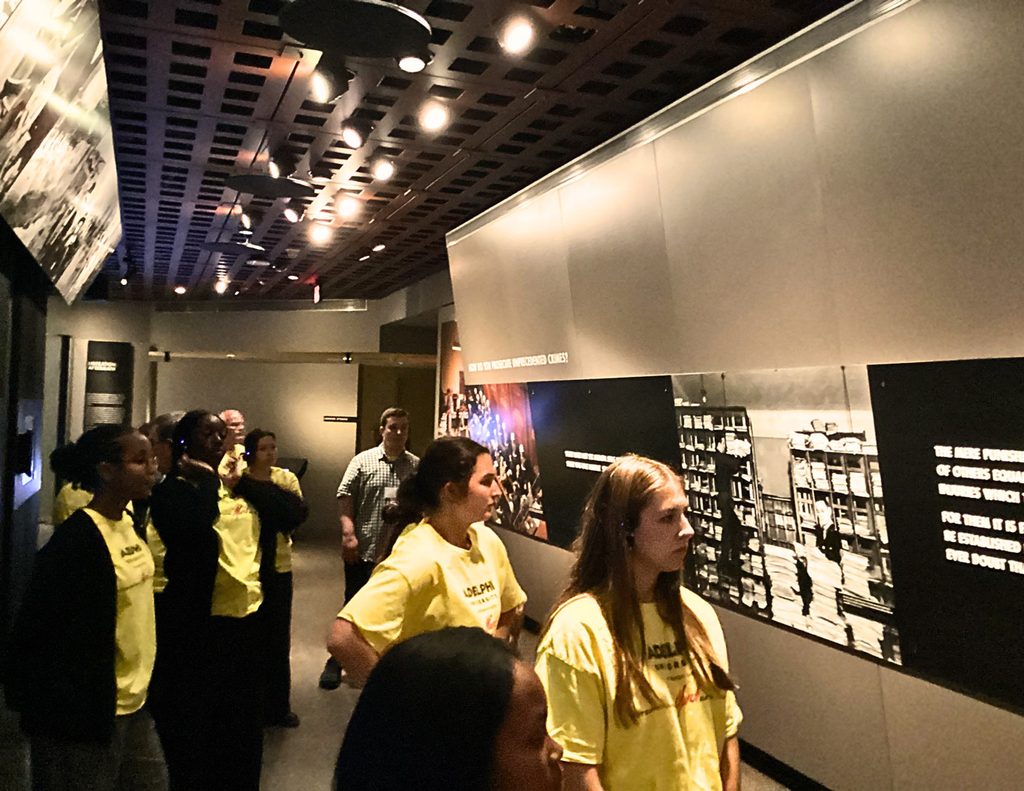
Moments from 2026.
Listening. Learning. Remembering.
Help the next chapter happen.
Support the experiences that turn learning into connection—and connection into action.
The Two Museums Program

© Two Museums Program 2026 | Design: Colin White